



Made with Your Magic, First Movement, Tunis
The Dream exhibition borrows its Arabic title, Suni‘a Bisihrika, from a phrase created to facilitate the memorization of the eight main Arabic musical maqâms. Each letter in this phrase represents the first letter of a main maqâm’s name. Maqâms are formal musical structures that have been used for centuries in a vast region that includes the Arab World and its neighboring geographies, extending to Central Asia.
Beyond their function as aesthetic structures, maqâms are charged with historical, cultural, social, and political dynamics that have formed over centuries. Examining the appellations and origins of these maqâms reveals that they reflect a rich artistic and cultural diversity beyond national, religious, and linguistic identity. They have endured through political shifts, cycles of exclusion and persecution, wars, and the collapse of empires.
The project draws inspiration from the signs and connotations conveyed by the histories of the maqâms beyond their sonic forms, in an approach that considers the contemporary moment in the region from which they emerged. In light of the geopolitical upheavals it has been witnessing, it is unavoidable to revisit questions of identity and territory, and to look at these shifts from within the sphere of art. The exhibition ponders questions related to the history of the maqâms as they reverberate into issues of minorities and identities, art and authority, and connections to land and other beings.
The exhibition is designed as a journey that intertwines closely with the old city of Tunis, featuring stops at ten buildings that host twenty-seven artworks. Audiences can stop at the eight cafes marked on the map, each playing a curated selection of modern and contemporary pop music based on a specific maqâm. Each space is an encounter, carrying its own story. Audiences can see a video made in 1988, get the new edition of a book first published in 1989, or discover the ten new commissioned artworks that were locally produced in Tunis. On the few-minute walk from one venue to the other, they can make their way through bustling commercial streets, through the slow pace of shoppers and the disoriented drift of tourists, to sudden quiet stretches, or find themselves in a street lined with shops dedicated to making and selling musical instruments.
The exhibition engages with the questions evoked by the history of the maqâms today, a pivotal time defined by momentous events. A reality that requires a re-reading of history and a reimagining of the world, which the space of art and creativity is uniquely capable of offering.
Maqam Saba: refers to “the crying of men” as it was called during the Abbasid era.
Maqam Nahawand: refers to the Kurdish city of Nahawand.
Maqam Ajam: means non-Arab.
Maqam Bayati: refers to the Bayati tribe in Iraq.
Maqam Sikah: Sikah is a Persian term where Sih means three and Ka or Gah means string. (Ziryab named it this way because it exclusively starts from the third note.)
Maqam Hijaz: Al-Hijaz is a historical region and one of the provinces of the Arabian Peninsula.
Maqam Rast: Rast means straight in Persian.
Maqam Kurd: Refers to the Kurdish people.
The artworks to explore by jouneys and locations :
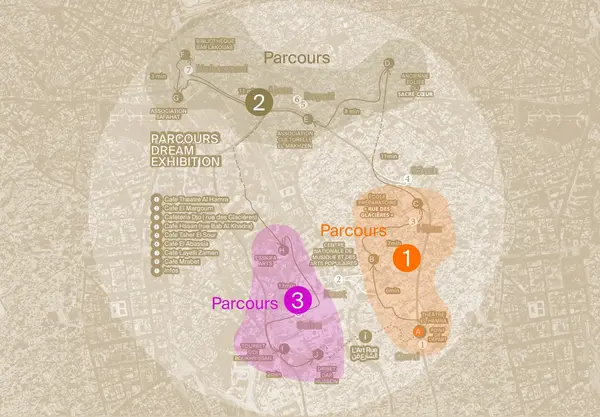
A. Immeuble El Doghri (Hamra Theatre)
Alla Abdunabi, I endured for you
Iman Issa, Das Spiel [The Game]
Alla Abdunabi, Foreign Bodies II
Joana Hadjithomas and Khalil Joreige, Ismyrna
Mona Hatoum, Measures of Distance
Noor Abuarafeh, If I Don’t Whisper, I Will Forget
Philip Rizk, Land Listening / سماع الأرض/ ⲅⲟⲩⲣⲓ-ⲛ ⲟⲩⲕⲕⲓⲣⲓ̄ⲇ /
Jumana Manna, A Magical Substance Flows into Me
Fredj Moussa, Land of Barbar: The Lion
Noor Abuarafeh, Memory of the Salt
B. Centre National de Musique des Art Populaires
Mounir Salah, To Hell With Art
C. Ecole de la Rue des Glacieres
Ala Younis, Battles in a Future Estate-Haifa Street
Walid Raad, Postscript to the Arabic edition
Philip Rizk, Mapping Lessons (The Lessons)
D. Ancienne Eglise du Sacre Coeur
Sonia KALLEL, The Grounding Point
E. Culture Association the Store
F. Bab Lakouas Public Library
Saif Fradj, The Road to Beb Bhar
G. SAFAHAT
Ali Eyal, 6x9 doesn’t fit everything and.
Ali Eyal, Look at what’s left inside the bag.
Iman Mersal & Kayfa ta, Archives and Crimes
Etel Adnan, The Arab Apocalypse
H. Eskifa Arts
Haythem Zakaria, Interstices Opus III
I. Tourbet Sidi Bou Khrissane
Ayman Zedani, To the Water Hunters
J. Dribet Dar Al Hussein



Mondafrique | « Dream City » investit la médina de Tunis du 3 au 19 octobre | Article in French
LE QUOTIDIEN DE L'ART | Dream City, une réponse arabe à la fermeture des frontières | par Melissa Gronlund | Article in French
diptyk | Dream City fait résonner la polyphonie des mémoires du monde arabe | par Farah Sayem | Article in French
e-fluxCriticism | Dream City 2025, “Made With Your Magic” | by Melissa Gronlund | Article in English
From 3 to 19 October
Access with Pass Dream Exhibition Parcours
Three journeys are available: 5 DT/journey/day
Children and students: 3DT DT
For online sales on Teskerti, a tax of 1,500 DT will be added to the price shown.